Saturday, 28 November 2015

Smoked Porter Carne Asada Tacos


I’m having a thing with tacos right now. It started over the summer when I made some using chicken brined in lager and lime, also using lager in the corn taco mix (this is in book four, Cooking with Beer, coming spring next year!). Then I had rauchbier pulled pork in tacos at a barbecue (also in book four…). Delicious things. And then I went to San Francisco and ate at five different taco places in three days. Since being back I’ve eaten tacos five times in two weeks…

Mates were coming over to drink all the IPAs I brought back from California, so I cooked up a huge batch of Smoked Porter-brined flank steak. Brining, I have learnt, is an incredible way to cook with beer, leaving beer-infused food that’s brilliantly tender, where the sugar-salt combo does magic things to meat. I used BeavertownSmog Rocket in these tacos. And I serve them with traditional California toppings of salsa, onion, coriander and lime.


Smoked Porter Carne Asada

Serves 6
1kg Quality Standard beef flank steak
2 cans of Smog Rocket (or another smoked beer)
5 tablespoons of salt
5 tablespoons of sugar
1 whole chilli, sliced in half
1 lime, sliced in half
1 onion, quartered
5 cloves of garlic
1 teaspoon habanero chilli flakes

In a large plastic container with a lid, mix the beer, salt and sugar until combined. Add the meat then the other ingredients. Top up with cold water until all the meat is covered. Place the lid on the container and put it in the fridge for 8-24 hours.

When you’re ready to cook, remove from the brine and dry on kitchen paper (discard the rest of the brine and ingredients). Slice thinly and then fry or grill on a high heat in olive oil for a few minutes.

Corn Tacos
Buy them – I use Cool Chile – or make your own as they’re really easy. You can also make them with beer: 250g masa harina, 330ml of beer and a pinch of salt. Mix it together into a dough, wrap in cling film for 15 minutes, unwrap, cut into small balls and roll into tacos about 3mm thick (even better, use a taco press) then fry in a dry pan for 30 seconds on each side.

Salsa
6 whole tomatoes
Half a white onion
2-4 chillis
2 cloves of garlic, chopped
Salt and pepper
Splash of beer (optional)

Roast all the ingredients (apart from the beer) at 200C for 20 minutes. Put in a blender and whizz until smooth. Add a splash of beer, if you like, then check the seasoning (I also add a squeeze of lime for more acidity).

To serve: stack two warm tacos (always two), place meat on top, add lots of fresh white onion, finely chopped coriander, a spoon of salsa and a big squeeze of lime.

These are great served with smoked porter as well – that beer loves the meat flavour and can handle the lime and spice.

I can see a lot more taco making in the next few months…


The meat for this was provided by Simply Beef and Lamb and it was genuinely some of the best English meat I’ve tasted. Look for the Quality Standard Mark in independent butchers and selected supermarkets to be sure that the beef or lamb is quality assured and responsibly produced by people dedicated to producing great food.

Tuesday, 24 November 2015

Tropical Fruit Juice IPA (or IPA in 2015)

Cellarmaker, San Francisco. At the forefront of new IPAs
The world’s greatest craft beer style, the one with the most storied history, the one most misunderstood, most widely brewed, has been changing for the last three centuries. And IPA continues to change and evolve faster than it ever has before.

Defining what an IPA is has become a difficult thing to accurately achieve. Right now, arguably the closest we can get is to say IPA is a beer that’s pale in colour and well-hopped, specifically for aromatics. I think we’ve even got to a place where IPA is a synonym simply for ‘hoppy’ and we require a prefix to tell us more precisely what to expect (Imperial, Session, Red, and so on), with many variations being brewed.

If we take IPA to mean the typical core-range American-style IPA then it’s likely going to be 5.5%-7.5% ABV, straw-to-amber in colour, hop-bitter and aromatic with US and new world hops, and that’s a very broad general description which doesn’t tell us anything specific about the flavours or subtleties – it’s like saying a cheeseburger is a meat patty topped with cheese between a sliced bread roll, but it mentions nothing of the finer details.

One approach, albeit limited, is to break down American IPAs into some broad geographic types, or ones linked to particular periods of time, which I attempted in The Best Beer in the World.


Seeing as the style is so fast-moving, I didn’t get to include the most recent American IPA trend, which I think evolves from the profiles of Oregon, Vermont and newer California IPAs, and which can accurately be described as Fresh Tropical Fruit Juice.

These new IPAs are unfiltered (sometimes hazy, sometimes properly murky) and very pale in colour. The intensity bitterness is low and character malts are non-existent. The time of them being super-dry and bitter has shifted towards softer, rounder bodies with some residual sweetness, though you don’t immediately notice that texture because the hop aroma is so dominant, so powerfully wowing, with the aroma sticking to the subtle sweetness in the beer, and giving the unmistakable qualities of fresh fruit juice – pineapple, mango, peaches, melon, papaya. There’s also a new focus on freshness to capture those aromas at their very juicy best – two weeks old is becoming too old (don’t underestimate this and it's not like these enjoy before they die IPAs: the draft-only, local-only – perhaps brewery-bar-only – hyper fresh IPA is nearby).

And notice that the pine resin, florals and grapefruit aromas are missing from the flavour profile of these IPAs – the classic qualities of American C-hops like Cascade, Columbus, Centennial are not present. And that’s relevant because these juicy IPAs are using newer hop varieties.

Citra was first released in 2007 but it took a couple of years before it was grown and brewed-with in larger volumes. The flavours in Citra (tropical, citrus, soft fleshy fruits) are different to those famous C-hop staples; they aren’t tangy, pithy, resinous or floral. They’re juicy.

At a similar time we got to try more Australian and New Zealand hops with their exotic tropical fruity aromas. Then came the next big hop releases from 2012 onwards: Mosaic, Equinox, Tahoma, Azzaco, Polaris, and more, plus newer European varieties like Mandarina Bavaria. These take that juiciness further and give even more tropical fruits plus melon and fragrant stone fruit. These new hops have changed the way IPAs taste because once we know it’s possible to make a beer smell like Um Bongo we crave more of its freshness. Bitterness, pine and grapefruit can do one – it needs juice now.

More Cellarmaker... They were the inspiration for this post thanks to their juicy, juicy beers
One side-effect of this change is how brewers are re-focusing on the American IPA. In the last five years we’ve seen the IPA-ification of all beers, like Black IPA, Belgian IPA, White IPA, Wild IPA, Fruited IPA, and so on, but we’re now seeing those sub-categories disappear. In their place are new IPAs. There’s IPAs using these new hops in new combinations, IPAs brewed with new hopping techniques from emerging research studies on hops, there are SMASH IPAs (Single Malt and Single Hop), hop burst IPAs, and more. It’s interesting that while the broader sub-categories seem to be disappearing, the Session IPA is an unstoppable style. And with this beer we’re seeing some of the best uses of these new hops and techniques (Stone Go To IPA, Firestone Walker Easy Jack).

IPAs currently account for around 27% of the US craft beer market, or seven million barrels of gloriously hoppy beers. In 2010 it was only around 12% of the market and one million barrels. That’s incredible growth, even more so when you consider that the craft beer segment is also growing exponentially – IPA is growing within a fast-growing category.
As well as growing up and out it’s still changing. It’s always changing; it’s been changing for 300 years, a liquid snapshot of brewing. These tropical fruit juicebomb IPAs (they are juicier than Juicy Bangers) are not like West Coast IPAs from five years ago. They’re not like the now-classic examples from 10-20 years ago (Lagunitas IPA, Racer 5, Odell IPA). These are today’s IPA where the never-ending search for newness and freshness continues to change what IPA is. And tomorrow’s IPA? Surely it can – somehow – only get juicier. Until it changes again.


Wednesday, 7 October 2015

Best Beer Book Launch: 13 October


On Tuesday 13 October I’m having the launch for The Best Beer in the World at Bottle Shop in Bermondsey.

I’ve picked some of my favourite beers to go on the bar (and you’ll get a few free ones if you buy the book on the night), I’ve ordered a lot of good cheese from Neal’s Yard and some St John Bakery sourdoughs, plus I’ll make a couple of cakes (using beer, obvs, and a tasty preview for my fourth book, which I've just finished writing…).

It'll start around 6.30pm and everyone is welcome, so come along and drink some great beers – the list currently includes Camden Town IHL, Birrificio Italiano Tipopils and Pilsner Urquell (which are the three free beers for book buyers), plus Burning Sky Saison Provision and Kernel’s Pale Ale Mosaic. And more to come...

I’m also starting to plan in other events and chats around the book. The next one will be at The Beer Shop London on Monday 26 October. That’s £15 for a bunch of good beers and a chat about the best beer in the world – the idea, the search, the conclusion.

If you plan on coming to the launch at Bottle Shop then let me know so that I can plan exactly how much beer we'll need.

Friday, 18 September 2015

Bia Hoi in Hanoi


I couldn’t quite take the picture in time. I saw it, fumbled to unlock my phone, fingers sticky from street food, and I tapped the camera icon, but the scooter carrying five silver kegs was already weaving through Hanoi’s never-ending traffic.

As we follow in the same direction I’m soon distracted. There are people everywhere, everything moves so fast, life condensed into the packed, stacked, compact streets; the air is thick with the smell of bubbling stock pots, an aniseed edge to every inhale coming from all the herbs, tropical fruit adding a fragrant sticky warmth; every turn reveals something new, something I’ve never seen before. Like Bia Hoi Corner.

Hanoi is a frantic, fast, exciting place

This famous intersection of bars has battered old beer kegs lined up on the kerb, people run around with trays of glasses, trays of fried food, the scooters weave in and out of all of it, and hundreds of people sit outside on tiny plastic stools, a dozen different languages bouncing around. It’s one of the world’s most exciting and lively places to drink, where the local beer, bia hoi, is unlike any other lager you’ll have had before.

Plastic mugs of the freshest, cheapest beer in the world

Bia hoi essentially means draft beer, the ‘bia’ bit derivate from the French ‘bière’, and it’s a pale lager, somewhere between 3%-4% ABV, brewed with malt and rice. That part is fairly normal for Asia. What makes it different is that after fermentation, at the point where lagers usually undergo an extended conditioning period, bia hoi is kegged and sent to bars. It’s fresh beer, a few days old, unfiltered and unpasteurised, with barrels delivered to bars every morning and emptied within a day, all served and drunk on the side of the street.

Kegs of bia hoi are all around the city, including small shops like this place, a couple of doors down from the main junction of bia hoi corner 

And that busy street-side experience is remarkable. When you sit on those plastic stools, knees under your chin, with your feet in the road, you’re given a tumbler, sometimes glass, sometimes plastic, of pale lager, and it’s something wonderfully simple in the middle of the madness.

Bia hoi corner at night

Bia hoi has the light, clean essence of Asian rice lager, made lighter by being low in alcohol and lacking depth because of its youth, the same youth which brings fruity esters of banana and strawberry. You also often taste the kind of caramel and buttery sweetness of Czech lager, reflecting the Czech influence on beer here (something surprisingly prevalent, especially so in Hanoi’s many brewpubs). The best bia hoi are really fine glasses of refreshingly bitter beer; the less-good ones aren’t worth worrying about when you’ve only spent 10p on it – it's one of the cheapest beers in the world.

100-litre drums of bia hoi sit outside a busy restaurant

While the liquid itself might be simple, understanding it is less so. All bia hoi is a bit different and the quality ranges. Different breweries make it (most big, some small), kegs change taste through the day, it changes depending on where you drink it, some bars have large drums of beer, others just tilt kegs on the roadside with barely any bar to house it; sometimes it cold, other times barely cool, some are great, others are ok, plus you never know who makes what you’re drinking because it’s free of branding; it’s just bia hoi, draft beer.

This is Vietnam’s beer and drinking it in Hanoi is a rare and wonderful experience. Nowhere makes or serves beer in this way, a fast-brewed, very fresh beer, kegs opened and emptied in one day before another delivery comes the next morning, where you drink on the street and the simplicity of the beer is the best kind of counter to the craziness of life flying by around you.


It’s worth knowing that you can also get draft beer that isn’t bia hoi – this is regular kegged lager from the local breweries, so if you specifically want bia hoi then you have to order that. And my favourite place to drink bia hoi wasn’t on Bia Hoi Corner, it was on the corner of Bat Dan and Duong Thanh (the top picture is the place) – lovely and bitter beer, in a place filled with locals eating good cheap food. There was also a place opposite (the one with the big 100-litre drums in the picture above) which was good.

Sunday, 13 September 2015

Wahleeah and cooking with beer

Yesterday I had beer-cured bacon with bacon stout ketchup for breakfast. I’d started making it a week earlier, brining belly pork in smoked porter, brown sugar, maple syrup and salt. I took the pork out of the brine on Friday morning and left it to dry out in the fridge, then cut thick rashers and fried them, the sugars caramelising, the beer giving a toasty, smoky flavour, and the pork itself more porky in depth through the curing process. It was delicious.

That bacon was something like the 75th recipe I’d cooked incorporating beer this summer (and a very big clue to what my fourth book, out next spring, is going to be…). So when I heard about Wahleeah, a restaurant specialising in using beer as an ingredient, I planned to go as soon as I could, which was last night. And I discovered that Wahleeah is way more than just cooking with beer.

Take the salt and pepper, for example. The pepper on the tables contains 11 ingredients. The salt takes three days to produce and contains horseradish and a process that involves smoking water. Diners shouldn’t even need to use them, says chef Dave Ahern, but if he has to have salt and pepper on the tables then he wants the best he can get with an exact flavour, and it turns out the only way to get that flavour is to make them himself. This obsessive level of detail is in everything – Dave makes cheese, vinegar, condiments, and more, for the restaurant. Beer is just one small part of it.

But for me, the beer part is the reason I’m there. Having spent the summer cooking with beer, I know all the good and bad things about what happens when you add beer into a recipe and I want to see what Wahleeah has done.


Oxtail and onions cooked in Fuller’s Black Cab Stout is rich with beer, full-on meaty with the onions giving a nice sweetness. There’s delicious crab cauliflower cheese, perfect with the suggested pairing of Weihenstaphaner Hefeweizen. There’s also beer-cured salmon with house pickles, stuffed mushrooms with beer and soy, a beer chilli to go on tater tots.


Larger plates include mussels in witbier with the addition of deeply-savoury ham hock, where it pretty much demands the beer on the side to act like part of the recipe, giving a freshness to lift the richness. A huge rib-eye steak comes with a brilliant beer fondant potato and a stout sauce, where that table salt and pepper gives it a remarkable extra depth of flavour (and recalls one of my favourite ever beer matches: steak, parsnip fries, horseradish sauce and oatmeal stout). There’s also ricotta dumplings with beer butter, tuna meatloaf with bloody beer sauce, bream with beer-braised fennel.


Then desserts: chocolate stout brownie with banana beer ice cream is superb and perfect with a bottle of Liefman’s Kriek, there’s also Porter cheesecake and Oreo trifle.

It’s all big-flavoured but elegantly done; next-level pub food incorporating the pub’s most central drink, but it’s not all about the beer – these are just great dishes that happen to contain beer. 

I love that Wahleeah is taking beer seriously – that’s the best thing about it for me. I love that the food is very good and I love how the beers used in the cooking enhance the dishes in their own subtle ways without ever overpowering – they are additional seasonings, they add depth which other ingredients can’t add, they give their richness, and they compliment the food. I also love how each dish comes with a beer suggestion – and that those matches are very well selected (done by Boutique Bar Brands). It makes the beer important and it encourages people to try new beers. And it has around 12 draft beers and 50 bottles, so there's a lot of choice. These are all good things.

Wahleeah is the first restaurant in the world to focus so completely on beer cooking. This could be seen as a gimmick, a Cereal Café for beer nerds, but Wahleeah really is way more than just cooking with beer. Surprisingly more. You should go.

Friday, 11 September 2015

De Garre Tripel in De Garre, Bruges


There were only so many beers I could write about in The Best Beer in the World and only so much space to pick out individual glasses of beer from the travels, meaning many important and wonderful beers didn’t get the space they perhaps deserved. Instead of going in the book, this begins an on-going series of some of the best beers and experiences I’ve had from around the world.
---

It’s just off the Grote Markt, perhaps 40 paces from the Belfry; you take a left and then a right and then you’re there. But I still walked past the tiny alleyway twice before I found it.

Here’s a clue: find La Belgique Gourmade and La Cure Gourmade and right between them is a small gap. You could stand directly opposite those brightly-coloured shops and still not see it. But it’s there, I promise. A few meters in and there’s the well-worn steps leading through a cloistered brick doorway and that’s Staminee De Garre, the place you’ve been searching for, a tiny dark bar with just a few tables and a few taps.

Order their eponymous house tripel and what arrives a minute or two later, on a paper-doilied tray, is one of the finest-looking beers in the world. A thick whip of Swiss meringue foam on top of just-hazy golden beer, the heavy base of the glass is like a fat door knob, the bowl is as sturdy as the beer within it, a beer powerful in its depth. There’s a fragrant peppery-orangey spiciness, there’s a hot sweetness in there, it’s boozy yet refreshing with the foam giving a smooth creaminess. And the cheese. It comes with cheese. These little cubes are the most perfect little tangy-creamy mouthfuls with that mighty brew.

One beer disappears too quickly, leaving its white lace down the glass, and you immediately want another because you don’t want to leave the little bar, don’t want to go back and brave the waves of tourists, don’t want to stop drinking this beautiful beer.

Don’t miss this place in Bruges. And I mean that quite literally; don’t miss the tiny little street with the big beer at the end of it.

Tuesday, 25 August 2015

My new book: The Best Beer in the World


Five years ago I drank the best beer in the world.

I was sitting on a hot Greek beach with a cold glass of lager and it was incredible. Nothing had ever refreshed me quite so completely, no moment had been more glorious than this one, no beer had ever tasted so good.

Yet I knew that this lager, served in a frosted glass, wasn’t the best beer that was available in the world. I knew there were beers that tasted better because I’d drunk them. It was only in that moment, when I wanted nothing more than this cold beer, that it struck me as perfection, as being the best.

And that made me think.

What could actually be the best beer in the world? Did such a thing even exist? What beers would be contenders? I got out a notebook and I started scribbling down ideas. By the time I’d drunk that cold lager I’d noted down what I thought were some of the best stories in the beer world. I also thought it’d make a brilliant book.

But I didn’t write the book. I was working full time in a college, I was writing blogs most days, I wasn’t ready to write something like that and I couldn’t afford to do the travel – I was just a 25-year-old guy who loved beer and wanted to drink lots of it. But the idea stuck with me and I’d regularly go back to it and add notes and more ideas, plus my drinking did essentially become a never-ending search for the best beers and the best drinking experiences. It was also a question people began to ask me when they found out that I wrote about beer: What’s the best beer? What’s your favourite beer?

Then I wrote Craft Beer World. I learnt a lot. And I thought that maybe now I could write this book, so I put the idea to my publishers. I ended up writing Beer and Food instead. Then once that was finished I went back to Best Beer, I developed it, I wrote a few chapters, and I knew that it was the book I wanted to write next.

The idea behind The Best Beer in the World is to tell the stories of some of the world’s most interesting and important beers. Each chapter is a long-form first-person travel piece which looks at the history and the present and also considers the actual taste.


I travelled as much as my wallet would allow (20 countries, over five continents, and to about 150 breweries...). I went to every brewery that I thought was relevant for a book like this. I lived like a monk at Orval, I threw Altbier and Kolsch into a fight, I tell the story of the original golden lager, I brewed my own perfect beer and went on my perfect pub crawl in London, I went IPA hunting in California, I stopped at Sierra Nevada to drink perhaps the most important beer brewed in the 20th century, I brewery-crawled around Beervana, I looked at what it’s like for a young couple to start a brewery in Australia and how they’re shaping the future of beer, I drank and danced at the world’s second-largest Oktoberfest, I went to China to drink the world’s best-selling beer, I spent 10p on the cheapest beer in the world, I drank the best-known beer in the world (and was blown away by how beautiful the brewhouse is), I tried to answer beer’s biggest truism (Is Guinness better in Dublin?), I drank sour beer at Cantillon, found myself at a remote farmhouse in Vermont, I drank the best Italian craft beers and then I went back to the beach and drank cold lager on a hot day, all in the search for the best beer in the world.


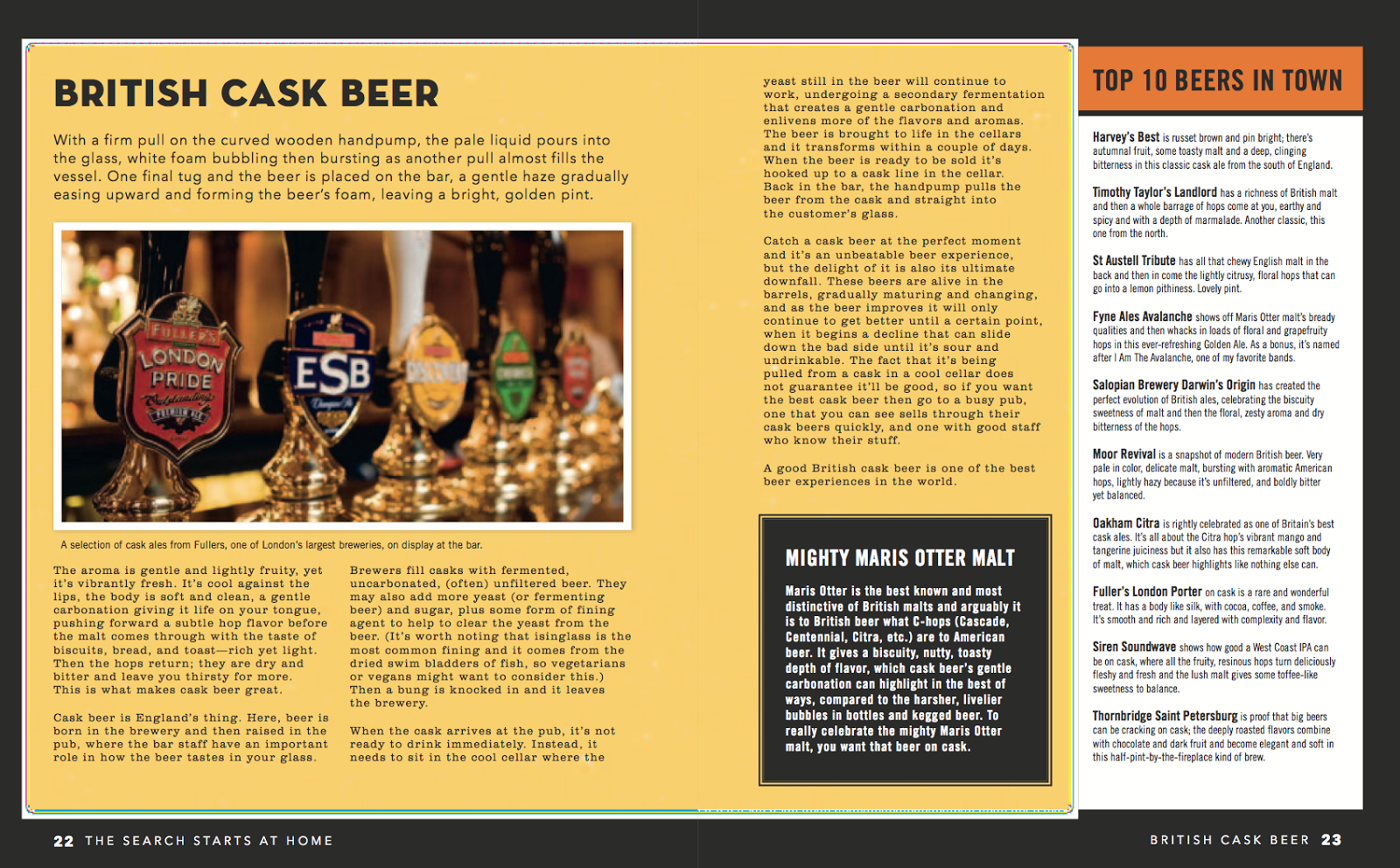
Alongside the longer chapters are some pages on topics like cask ales and the history of IPA, plus travel guides to around 25 of the top drinking cities in the world, so it’s also a practical guide to beer drinking. And did I find the best beer? Well, that’s almost not the point of the book. With The Best Beer in the World I wanted to take a broader look at world beer, to tell some stories that haven’t been told before, and to appreciate the search itself, the travel, the people I met, the things I saw and learnt, and to consider all beers as being relevant. 


The book is at print and due out in October. It’s available on pre-order (and from my publishers) and it’s very different in content to the previous two books. I’m excited for this one to be released.